
The only consciousness we know for certain exists doesn’t inhabit a power-hungry, water-guzzling server farm. It sits in the warm, wet machine between your ears, running on roughly the power of a dim light bulb.
That has not stopped some people, even the odd Nobelist, claiming that they have witnessed the stirrings of artificial consciousness in large language models. Chat with an LLM for long enough and the illusion can be powerful. The machine seems to reason, joke, confess and even to care. These plausibility machines appear to have sailed through Alan Turing’s famous imitation game. But seeming like a mind is not the same as having one.
Turing himself knew that computation has limitations. Long before the current wave of AI, he showed that there are well-defined mathematical problems that no idealised computer can solve. That does not settle the question of machine consciousness, of course. However, it should make us wary of the breezy assumption that digital computation can reproduce anything a brain does.
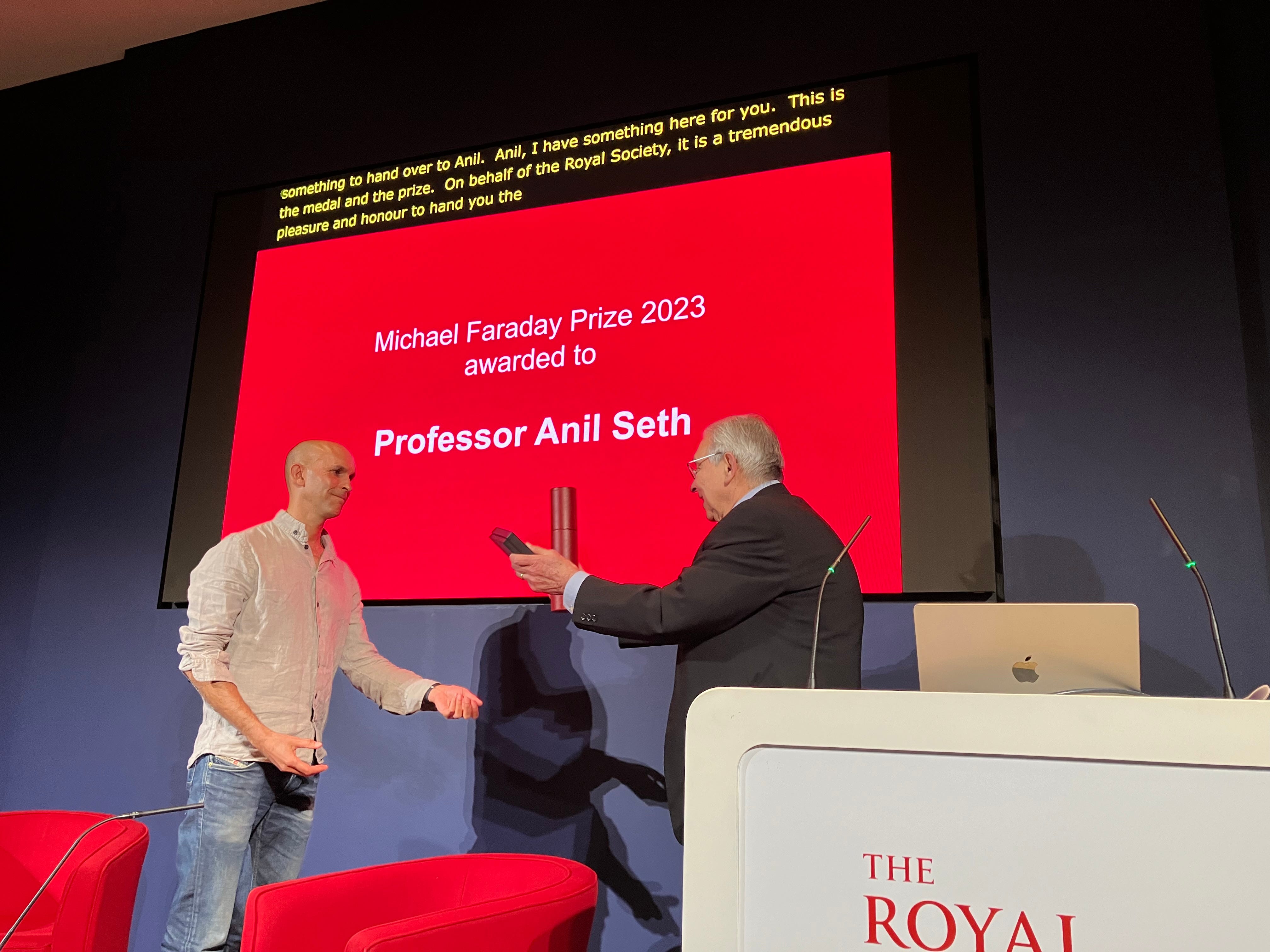
All this came to mind in a recent exchange on X with the neuroscientist Anil Seth.

Anil has warned about falling into the trap of digital pareidolia: our habit of seeing minds, intentions and agency in LLMs similar to how we see chihuahuas in muffins, or Jesus staring out of a piece of burnt toast. (More in my Royal Society Attenborough talk, eight minutes in).
There’s a lot more to his objections to digital consciousness, which he thinks is vanishingly unlikely, and Anil has set out the reasons for his scepticism in a TED lecture and a 2025 paper in Behavioral and Brain Sciences.
Discussing anything complicated on X is fraught and I was trying to focus on one assumption behind many optimistic forecasts of digital consciousness, which rest on what is called computational functionalism. This in a nutshell says that mind depends not on the stuff doing the work but on the computation or, more specifically the algorithm being implemented. Harness the correct set of computations in a computer and consciousness boots up too.
Recently, an MIT team proposed in a review that the brain’s ability to generate nimble thoughts rests on what they call analogue computations. While digital circuits make calculations through switches and gates, analogue computation can result from the interference of brain waves, which is also highly efficient.
Fine. If analogue computation is behind consciousness, why not simulate this activity on our seemingly flexible friend, a digital computer? By this view, building a conscious machine would require reproducing the analogue waves themselves with exquisite fidelity.
But the assumption that a digital machine can do everything an analogue one can may be shakier than it looks. That is the upshot of work by my co-author Peter Coveney, who has been exploring the limits of digital computation, as Director of UCL’s Centre for Computational Science.
Digital computing works by shoehorning the analogue physics of silicon into crisp categories: high or low, one or zero. A lot of engineering, and a noticeable chunk of AI’s electricity bill, goes into this tidy thinking.
Analogue machines do something different: they let physics do the computation directly. They harness continuous physical phenomena, such as voltage, water flow or light waves, to represent quantities and solve equations. That is one reason the brain runs on roughly 20 watts, while modern AI increasingly relies on server farms that draw gigawatts of power.
This is pertinent because life is not a neat, linear spreadsheet-like affair. Brains, bodies and cells are packed with nonlinear processes, feedback loops and chaos.
A famous warning of what happens if digital neglects the nonlinear richness of the real world came in 1961 from Edward Lorenz at MIT. He tried to rerun part of a weather simulation but typed in rounded numbers from a printout.
This apparently tiny change sent the virtual weather veering into an entirely different future. That became known as the butterfly effect: in a chaotic system, imperceptible differences in the starting conditions can bloom into huge differences later on.
Peter - working with Bruce Boghosian and Hongyan Wang - explored this problem in digital simulations of chaos.
The problem is simple to state. Analogue quantities can, in principle, vary continuously. But digital computers must choose from finite sets of numbers. They only use a subset of what are called rational numbers, when there are infinitely more of what are called irrational numbers. That means they capture only a vanishingly small sample of mathematical possibilities.
In fact the reality is even stranger.
Take 32-bit single-precision arithmetic. It offers about four billion possible bit patterns. Most encode finite floating-point numbers; some are reserved for infinities and so on but this is a long way from analogue’s continuum. Nor are these numbers sprinkled evenly along the number line. They crowd near zero and thin out as values grow.
To see whether this matters, Peter and his colleagues turned to a stripped-down chaos generator called the generalised Bernoulli map. Start with a number between zero and one. Multiply it by a constant greater than one. If the result exceeds one, keep only the remainder. Repeat. Out of this simple rule comes behaviour that looks random.
The problem comes when you compare the output of a digital computer with the mathematical reality of the Bernoulli map.
For some choices, notably an even-integer multiplier in standard floating-point arithmetic, the predicted behaviour can be qualitatively wrong. For more typical choices, the simulation may look reassuringly plausible while still drifting into significant error.
And, no, you can’t erase this pathology with more digital precision, that is, more digits.
A digital simulation of a chaotic system is not always a slightly blurred copy of the real thing. Given enough time, it can become a different creature altogether. Thus if consciousness depends on faithfully reproducing the dynamics of a living analogue brain, we should be sceptical that ordinary digital machinery has a rich enough mathematical palette.
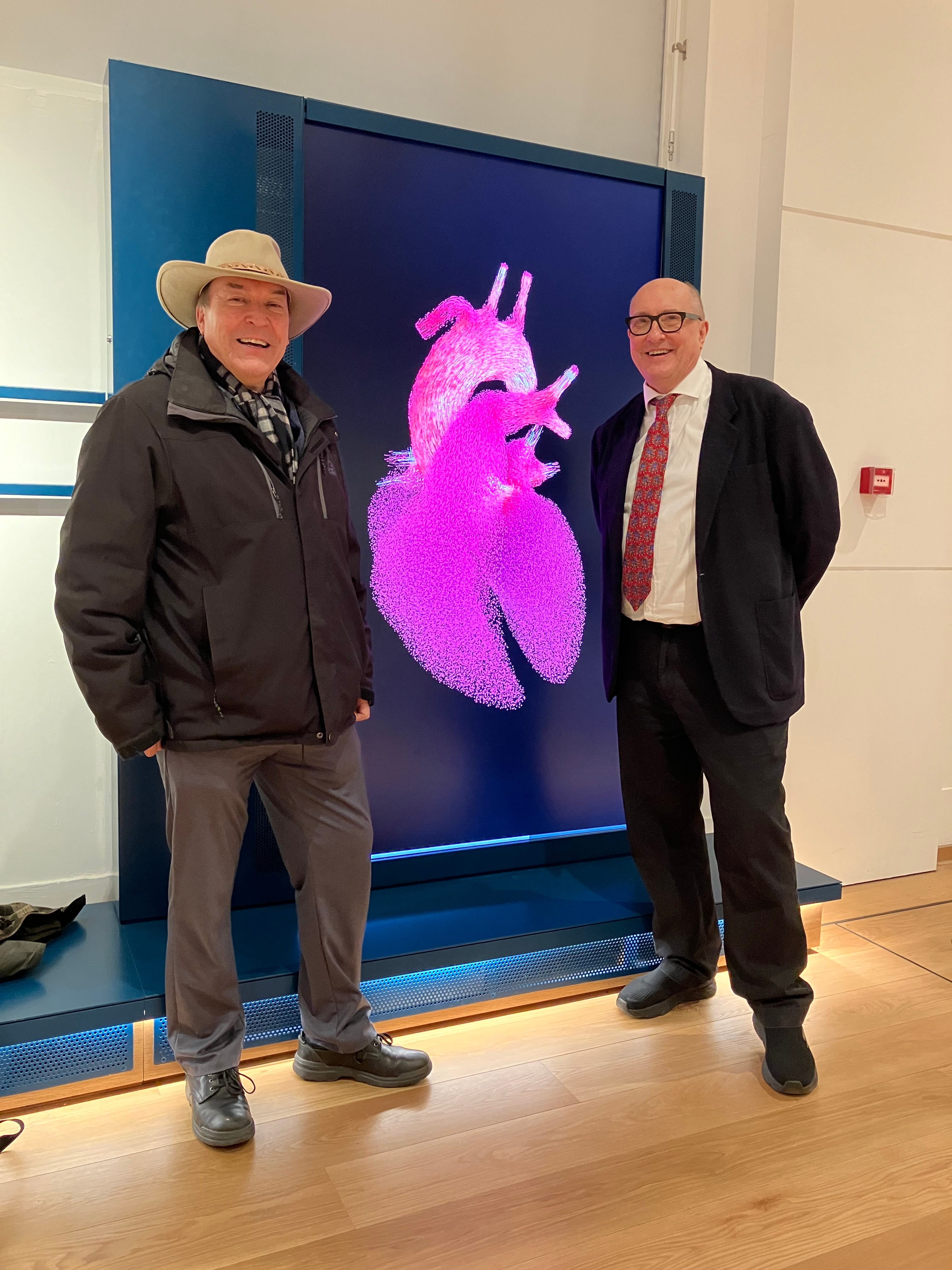
Anil would go even further, arguing that simulations are not instantiations. In other words, a simulated rainstorm does not leave puddles inside the computer. Nor will a model fire toast your marshmallow. And although Peter and I have written at length about digital twins of living things, neither of us thinks that a digital version of a beating heart is alive, even though they are jolly impressive.
If artificial consciousness is possible, it may not emerge from ever larger language models running on digital computers in ever more power-hungry server farms. It may require machines whose physics is not an inconvenient detail but the entire foundation of how they work: highly efficient analogue systems in which the computation is bound to the substrate that carries it out.
This is what AI Nobelist Geoff Hinton calls ‘mortal computation’: where software and hardware are inseparable, so the program only works on one kind of physical hardware and would perish if that hardware breaks (digital computers separate software from hardware, allowing the same program to run on any machine, making the software “immortal”).
Though more controversial, I feel I should also cite another Nobelist, Roger Penrose, who uses a famous mathematical concept (Gödel’s theorem) to argue that humans can look at a problem and see that it is true, even though a digital computer following a strict set of rules (an algorithm) would get stuck and never prove it.
Bottom line? The long-term future of AI may turn out to rest on old-fashioned analogue processes of the kind that endowed us with intelligence and consciousness long before the rise of digital computers.