
Most of us learn about the latest science through social media, news stories and press releases, and the story usually goes something like this: researchers identify a problem; researchers apply a clever method; researchers solve the problem; and everyone jumps for joy.
I wrote a version of that story a few months ago about a team at University College London which had used quantum computing to make make AI smarter. I went on to praise ‘Quantum Informed Machine Learning’ this week at New Scientist’s 70th birthday celebrations in the Science Museum.
To be exact, the team had used a quantum computer to stop AI drifting into nonsense when it tries to predict chaos. This fundamental problem sounds arcane but the study, published in Science Advances, is of huge importance when using AI to predict turbulent flow, which is critical for aircraft design, weather prediction and nuclear fusion.
What struck me most was that the UCL research offered evidence of something rare, a practical quantum advantage: a quantum computer outperforming a classical one on a problem scientists actually care about. The literature is littered with papers that prove quantum advantage on problems that don’t really exist, which are somewhat reminiscent of those world records for deeply pointless activities, such as who can put the most snails on their face (yes, really) and so on.
My little blog was accurate as far as it went. But it left out the interesting bit, which is how the UCL team managed to do it and, no, it was not thanks to a couple of tech bros hashing things out over a beer in a Silicon Valley garage.
So, I went back and talked to Maida Wang, the joint first author, to walk me through how research is actually done, which is important if we are to persuade the public that science is not about facts and opinion, it is the best method we have to understand how the world works.

Maida is 26, with a background in mathematics at Wuhan University. He approached the head of the UCL team, my old friend and co-author Peter Coveney: “I emailed him from my WHU address, and amusingly he initially thought “WHU” stood for West Ham United rather than Wuhan University. From there, we started discussing possible PhD work, which eventually led to me joining UCL and working with him on quantum informed machine learning.”
Maida’s motive
The UCL Centre for Computational Science runs HemeLB, a vast tract of computer code used to simulate blood flowing through the thousands of kilometres of blood vessels in a human body (more about personalised medicine and digital twins, in my book - with Peter Coveney - Virtual You).
To underline how epic this undertaking is, HemeLB runs on one of the biggest computers on the planet in Oak Ridge National Laboratory, Tennessee. Frontier is an exascale computer, one that crunches more than 1 quintillion (a billion billion) calculations per second.
The problem the UCL scientists faced is that blood flow is chaotic in the technical sense, meaning tiny differences in starting conditions can send the outcome wildly off course. This is the famous ‘butterfly effect’, where the flap of a wing can trigger a tornado, only in a blood vessel.
The team had been using AI, specifically transformer models of the kind that sit under the bonnet of large language models. A transformer-based LLM is an AI that reads blocks of text in one go and uses a mathematical “attention” mechanism to understand how words relate to each other.
But it soon became clear that the AI alone was not up to the job of predicting how blood flow would evolve, explains Maida. “After a short-term evolution, it works fine,” he said. “But after long-term evolution, suddenly the prediction just gets worse.”
“The reason is simple,” he continued. Those small errors compound. Eventually the prediction stops being a prediction of anything and settles into a mushy average.
The scientific literature offered a possible solution through what is called ergodic theory. Here is the official line: when what you study operates under ergodic conditions, the long-time statistics observed along a typical trajectory agree with the statistics described by the system’s invariant distribution. Put simply, follow one swirl of blood for long enough, keep a tally of how often it runs fast or slow, and your tally ends up matching a fixed statistical fingerprint of the whole flow.
That fingerprint is the invariant distribution. It stays the same, even though the blood flow never stops churning. This fixed statistical pattern can be used as a kind of guard rail for the simulation, stopping it from drifting into nonsense.
The HemeLB team wanted to use a second transformer-based model to learn that all-important invariant measure to keep their predictions honest. But, explained Maida, that demanded a vast amount of compute to succeed, given that HemeLB is already a monster of a program.
One enormous AI to police another enormous AI. It works but it costs a fortune in compute. Elegant, it ain’t.
The tea break
Maida first pondered the potential of a mash up of AI and quantum one afternoon in February of last year, at a tea break in the UCL Department of Chemistry near Euston. The HemeLB fluid dynamics team had been explaining how they were using one big AI to fix the problems with another. For Maida, a quantum computing scientist, the fix was obvious: “Why don’t we use a quantum computer to deal with it?”
Quantum computing is still at an early stage, but two fundamental properties of quantum circuits made him think they’d help.
The first is capacity. A quantum computer can hold a colossal number of possibilities at once because its basic units of information (qubits) can exist in a “superposition” of multiple states simultaneously, mapping their combined data into a mathematical arena known as Hilbert space, explained Maida.
In this abstract space, every additional qubit doubles the available dimensions, so the computer’s capacity scales exponentially rather than linearly. Thus, to describe a space of a given size, the number of parameters a quantum circuit needs grows only logarithmically, so any problem can be handled more efficiently as it expands.
The second reason quantum computing is handy is more subtle. Instead of tracking the tangled motion of a chaotic flow directly, you can track how the things you’d measure, such as speed at a given point, change over time. It’s a trick that dates back to work by the American mathematician Bernard Koopman in 1931. For flows like these, that change turns out to be unitary: orderly and lossless, with nothing stretched, shrunk or thrown away.
You can envisage this property is as follows. Imagine turning a sculpture of blood vessels in your hands. You see a different view from every angle, and the thing itself looks changed, but no part of it has been added, lost or worn away, and you can always turn it back to where you started. That’s the gist of being unitary, a crucial property shared by blood flow and a quantum chip.
The UCL team nudges its AI to handle the flow in this way, and quantum circuits are also unitary by nature. The two speak the same mathematical language. “To use quantum computers for this problem is a very natural mapping,” said Maida. “That brought me to realise we should use the quantum computing to learn the invariant measure instead of another transformer-based model like a large language model.”
The response of the HemeLB team was predictable: “We don’t really understand quantum computing,” they told Maida. “Maybe you can give it a try.”
“That was the beginning of my research,” he said.
What quantum contributes
The method Maida and his colleagues created is called Quantum-Informed Machine Learning, or QIML, and the trick is that the quantum machine does one job, once, and well. It learns a compressed summary of the statistical rules a turbulent flow must obey, known as a Quantum Prior or Q-Prior, and hands that to a conventional AI, doing away with the second power- and compute-hungry transformer-based model.
While a transformer is just trying to learn the dynamics of blood flow, Maida likens the Quantum Prior to a map for navigating unfamiliar terrain. I wanted to know what a reader would see if you printed it out. When it comes to HemeLB, he said the Q Prior “describes the velocity of the whole chaotic flow.”
For flow modelling, the Q-Prior offers a compact statistical description of quantities such as velocity. It won’t tell you where the blood is heading at any given moment. It gives the long-run profile of how fast it tends to move, packed into a few qubits
The published study built its Q-Prior from the plain probabilities you get when you read out the qubits. But in follow-on theoretical work, posted in June, the team showed there’s more to be found. The way the flow evolves can be written out as a big grid, or matrix, of numbers. A classical model normally only reads the diagonal of that grid, the plain probabilities.
A quantum circuit, measured in a smarter way that reads pairs of qubits together, also picks up the off-diagonal terms, which capture how different outcomes relate to each other. They’re faint but not negligible (think once again of the flap of that butterfly’s wings) and they carry physics the classical model never sees. That’s the deeper reason why a quantum machine can learn the flow’s rules better.
No Eureka!
Simulations of blending quantum computing with AI were encouraging. In theory, Maida knew that this could work. But, of course, it was not just a matter of wiring up a real quantum machine to an AI. Real quantum hardware is fragile, and errors creep in.
“I’ve tested the noise on quantum machines,” he said. “It made me nervous whether those kinds of devices could just ignore the noise and get the results like the ones from the simulator.”
The UCL team started using IQM Quantum Computers’ Emerald chip, which has 54 qubits, in Finland. The surprise was that this turned out to be too many, in a world where most assume that more qubits usually means better. “At the beginning, it did not go that smoothly,” said Maida. “We could not get the best result that we wanted. The reason is that Emerald has too many qubits and the noise proved too much.”
“I asked IQM whether I could get a lower number of qubits, but with higher fidelity. They offered us their Garnet chip. We tested it several times, using an error mitigation method to reduce noise. And then at last, we had some results.”
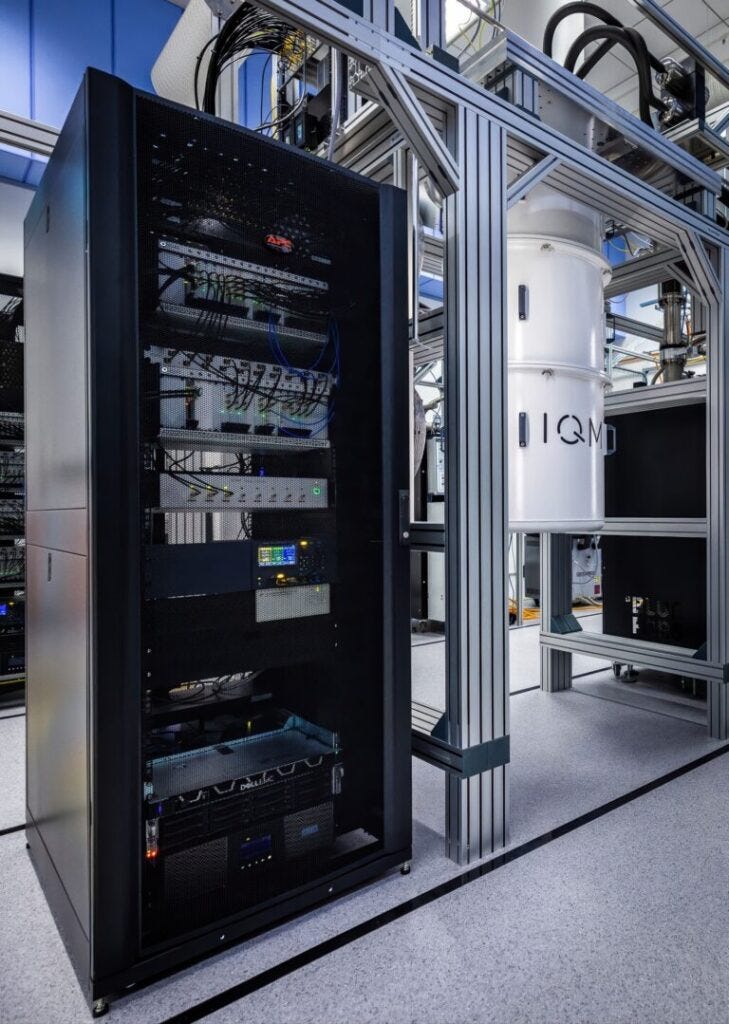
The other headache the UCL team faced was a matter of plumbing, just the sort of unglamorous but important stuff that nobody puts in a press release, said Maida. “One challenge was how we connected the quantum device with the classical computing resources for the AI.”
Another hurdle was that the two machines lived on different clouds. Fortunately, Peter Coveney had many industry contacts to help them make that all important connection between quantum and classical AI.
More flexible than thought
I asked whether there’d been champagne and celebrations when Garnet finally delivered results. “Well, no,” admitted Maida. “We had already seen these beautiful results on the simulator.” The hardware result confirmed something rather than revealing it.
However, they were surprised at how flexible quantum informed machine learning turned out to be. They tried it out on three well-known (at least, to scientists) chaotic systems, with somewhat arcane names such as the Kuramoto-Sivashinsky equation, 2D Kolmogorov flow, and 3D turbulent channel flow.
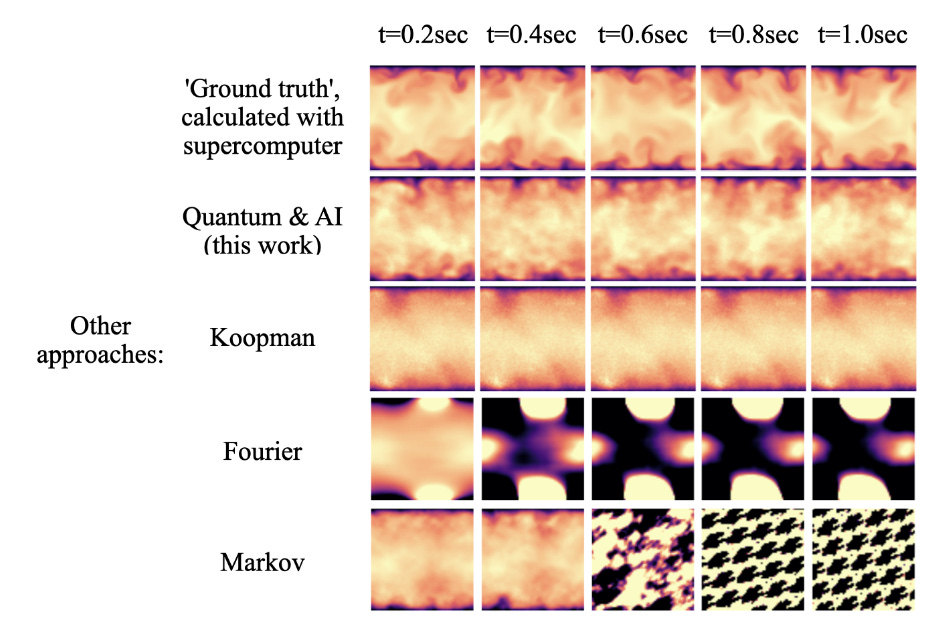
Quantum-Informed Machine Learning was up to 17.25% better than classical AI at getting the overall statistics of the flow right. It was up to 29.36% better at reproducing its energy spectrum, the way energy is shared between big eddies and small ones, which is the signature of real turbulence.
“We are very surprised that this QIML method works across so many different systems,” said Maida.
And then, in the wake of their paper, they applied it to HemeLB too, the original spur for the research. “The shocking thing is that it also works for blood flow,” he said. “That is very different from the other chaotic systems, such as the weather. It really works.”
Couldn’t you do it classically (with a normal computer)?
This is the question that has torpedoed one quantum advantage claim after another, and Peter Coveney, Maida’s supervisor and co-author, has been rightly wary of big tech overclaims which, when challenged, have crumbled and then quietly been forgotten.
I put it to Maida directly. Has anyone come along and said you don’t need the quantum bit? Their published study showed the quantum approach doing better than every classical rival it was tested against, using fewer adjustable settings and far less memory. “In fact, we also tried to use a larger classical model that has millions of parameters, but it eventually failed.”
But the follow-on work goes further, with a mathematical proof, not just a benchmark, that on one precisely defined measurement task the quantum machine has an edge.
Maida doesn’t rule out that a far bigger classical model might eventually catch up. But, as he put it, “this could take more time and more resources”, whereas the Q-Prior does the job with remarkably few. The Q-Prior itself used only 10 to 15 qubits, spanning a Hilbert space of 1,000 to 60,000 dimensions. This prior cuts the demands for data storage by more than two orders of magnitude. Maida puts it more starkly still. “I think we just use kilobytes compared to gigabytes.”
What next?
Given the traditional transactional narrative about science and wealth creation you might expect a young quantum researcher would come up with a pitch about industrial deployment and untold wealth for UK plc.
“At the moment, we are not trying to build another quantum information device,” he said. “We are seeking deeper understanding about those physical phenomena and which level of information we need for the prediction. We are not likely to do industrial things yet - we’re scientists.”
The Q-Prior, according to Maida, isn’t just a tool for making better forecasts. It’s an instrument for dissecting which bits of a chaotic system’s statistics matter. “We are also trying to know more about the underlying physical information, which part of the statistics is essential for the prediction. I think this [Q-Prior] is not just like a tool, but it’s something that can help us to get deeper understanding and scientific insights.”
Maida allows himself one look even further ahead, to the arrival of fault-tolerant quantum computers that correct their own errors as they go. When they come, he thinks this hybrid of quantum and classical AI could be used more widely and on far bigger problems.
The teacher
While a transformer-based model learns the dynamics of blood flow, the Q-Prior tells it which way the simulations can’t go, like a teacher, akin to the way humans point AI in a direction with prompts.
In the journal Frontiers in Physics, Peter Coveney has argued, with me as co-author, that the usual question about quantum computing and artificial intelligence is often back to front.
Everyone asks what AI can do for quantum computing. The real question is what quantum computing can do for artificial intelligence. On the strength of what came out of that tea break in February 2025, the answer is the following: build in the physics to keep AI honest.
A fabulous piece. Thanks Roger!