
Time is running out to see Arcadia, as the return of Tom Stoppard’s thrilling masterpiece to the West End draws to a close on 12 September. Seeing all the ballyhoo around the latest production transported me back to the early 1990s, when Arcadia first opened at the National Theatre - and when I played a very minor supporting role.
In 1992 I helped organise the first of many “scientists meet the media” parties for The Daily Telegraph, which was held that year at the Science Museum. There, my Telegraph colleagues Max Hastings and David Johnson steered me towards Tom Stoppard, who told me he was keen to find out more about chaos theory.
Standing nearby was Professor Robert May. I made the introduction.
Bob was the perfect contact. At that time, while working in Oxford and Imperial, he had put chaos into biology by showing that simple population models can produce complex, chaotic behaviour. He was a brilliant, brash Australian polymath, liberally applied the F word, and went on to become Government Chief Scientific Adviser, President of the Royal Society and Lord May of Oxford.
Bob died in 2020, aged 84, while Tom Stoppard died at home last November, aged 88. It is lovely that the Duke of York’s Theatre, where this production of Arcadia is playing, has been renamed the Tom Stoppard Theatre. Carrie Cracknell’s revival has received widespread praise as a moving tribute to the late playwright.
Here are my early reflections on the world premiere for The Daily Telegraph in April 1993 which were informed by my first book with Peter Coveney, The Arrow of Time, along with a second article I wrote about how Bob shaped Arcadia. Both predate the web as we know it, and both are otherwise hard to find.
The Arts: Stoppard solves the problem - Tom Stoppard has baffled and dazzled the critics with his new play about chaos theory.
How successfully do drama and science mix? Roger Highfield, our science editor, gives the author full marks for presentation
15 Apr 1993 Daily Telegraph
By ROGER HIGHFIELD
TOM STOPPARD has admitted that he lives in fear of a smart alec in the audience spotting a scientific flaw in his latest creation. Far from finding fault, I can say, as co-author of a book which explores the scientific themes found in the play, that I felt moved to shout for an encore on its opening night.
Arcadia interweaves action from two periods, one contemporary, one around the start of the last century. It deals with the transition from classical to ‘picturesque’ landscape gardening and includes a detective story, the quest of an unscrupulous don, Bernard Nightingale, to develop a Byron theory sensational enough to grace the pages of the Sun. But the most powerful thoughts of the play - subject of the best performance of the evening - emerge from the scientific ideas glimpsed by the young heroine, Thomasina Coverly.
For the first time, I joined that elite - and smug - set of theatregoers, those who tell us how clever they think they are by the occasional snort or giggle at obscure cultural references.
But does the science work on stage? Without a doubt. Stoppard successfully avoids worthy-but-dull education to concoct an enlightening entertainment.
Too much explanation, and the audience could find itself at a physics lecture. Too little, and scientific terms would become meaningless jargon.
I missed Hapgood, Stoppard’s last and reportedly less successful attempt at plundering science for ideas. The feeling that Arcadia works better may have much to do with Stoppard’s subject matter: the quantum mechanics that inspired Hapgood provides a description of the subatomic world that baffles as many scientists as lay people. Arcadia is about a new science that is attempting to describe the complex and chaotic behaviour of the real and visible world.
Stoppard’s starting point is Newton and his classical laws of motion, which are insensitive to the direction of time and seem to leave no room for unpredictability or free will. This mechanical universe has been shattered by a contemporary field called non-linear mathematics, given the trendy (and misleading) name of ‘chaos theory’. It is a rich area of study that rescues free will and chance, giving full rein to the uncertainties of love and sexual attraction that unfold in the play.
Stoppard tackles chaos with flair, illustrating it through Valentine Coverly’s study of grouse populations, and showing how the discovery of only some letters describing events of 1809 feeds back into a different account of the same events by Nightingale.
The play also delivers potent images through a new irregular ‘fractal’ geometry, beautifully suited to describing the messy bits and behaviour of the real world. Clouds, lungs, mountain ranges and cauliflowers are fractal objects, ones that reveal similar shapes and motifs at every level of magnification. Stoppard’s play seems to be similarly constructed: from the dialogue and musical accompaniment to the use of character and prop.
The chug of a steam engine in the second act heralds another underlying theme connecting chaos and Newton’s flaws: the science of heat, called thermodynamics. Born from a pragmatic effort to improve the efficiency of steam engines, this demonstrates that change will ceaselessly occur until the capacity for change is spent. Another formulation of this - the Second Law of Thermodynamics - is that disorder increases at the expense of information: the modern quest of Nightingale to find documents to back his Byron theory is thwarted as crucial letters are burnt.
Stoppard also draws on one cosmic formulation of the Second Law: the ‘arrow of time’ that points from the Big Bang of creation towards heat death, when all that is left is a thin cool gruel at constant temperature. This grim fate is suggested in Byron’s poetry, the eerie final waltz, which mixes characters from the two stories in Arcadia, and even in Thomasina’s interest in stirring jam into rice pudding.
Could Thomasina really have foreseen chaos theory, as a teenager living at the start of the 19th century? Do similar scientific ideas sprout in different periods and from different people? And do they outlive their proponents? Yes, on all counts.
At the age of 16, Einstein started to wrestle with the ideas that would overturn Newton’s picture of time and space. Poincare had already begun to reveal the mathematics of chaos in 1889. Kovalevskaia showed that it was possible - just - for a woman to make an impact in mathematics during the 19th century. Carnot’s ideas about heat engines far outlived his tragically short life.
Similarly, Thomasina’s efforts to describe the fractal geometry of a leaf (her ‘New Geometry of Irregular Forms’) presage the mathematics Benoit Mandelbrot developed when working for the computer giant IBM in the 1970s.
Her mission would have been mind-numbingly difficult without a calculator.
And Stoppard nicely makes this point by committing her tutor Septimus to an insane bid to continue her quest.
Because science always plays second fiddle to the arts in national culture, my initial thoughts were on whether the science is merely a prop to bolster the plot or a thin layer of intellectual veneer concealing something deeper about human nature.
Now I am convinced that it is a virtuoso display of science portrayed in dramatic form, not simply decoration. After all, why can’t scientific ideas be the core of a play? Arcadia’s final drama, the death of Thomasina, is only suggested. How fitting that she should come to a thermodynamic - perhaps thermodramatic - end. Before her genius can be recognised, she is consumed by flames.
The Arts: The day art met science - How an Oxford professor helped to put the chaos into Arcadia
By ROGER HIGHFIELD
IT IS rare for a playwright to seek the opinion of a mathematical biologist for his latest work. But Tom Stoppard and the cast of Arcadia have drawn on the talents of a Royal Society research professor to put the chaos into their production.
It was at The Daily Telegraph’s science party last year that I introduced Tom Stoppard to Professor Robert May, of Oxford University and Imperial College, London, after learning that the playwright was keen to find out more about chaos theory.
That led to a dinner soon after, when professor and playwright discussed Arcadia. May gave advice during a seminar with Stoppard, Trevor Nunn and the cast and then saw the play on the first night of the previews.
Unfortunately, the Easter meeting of the British Ecological Society in Southampton prevented May from attending the first night. What he has seen so far impresses him. ‘I hope it does well,’ he says.
‘But you do have to discount everything I say,’ May added. ‘First of all, I am a Stoppard fan and always have been. Secondly, it is an absolutely magical cast.’
It is one that May has done his best to indoctrinate with chaos theory. Two of the younger members visited his laboratory in Oxford for a day: Samuel West, who plays a modern character attempting to develop a mathematical equation to model swings in grouse populations; and Emma Fielding, who plays Thomasina Coverly, the prodigy who stumbled across chaos theory in the early 19th century.
May was overwhelmed by their professionalism: ‘It was like dealing with a bunch of graduate students and people who really wanted to understand what it is all about.’
One of May’s graduate students, Alun Lloyd, developed the ‘Coverly set’ for Fielding’s character, a reference to a simple mathematical formula that can spout the complex patterns her character sought, given enough number crunching. ‘Emma Fielding spent at least half a day doing just that,’ May says.
May says there will always be a scientist or mathematician who claims the play is not explicit enough. If there were any more mathematics, however, the play would be ‘bound to be a flop’.
But could he link chaos with the other themes that emerge in the play?
‘Well, you will have to decide that when you see the play. On the one hand they are very separate and, on the other, the arrow of time pervades the whole thing.’
In the wake of the party, I saw more of Tom Stoppard. We met for lunch. He was delighted with my review, polite and chatty. I felt overwhelmed.
Much to my amazement, later that year he came to the launch of my Einstein biography (written with brilliant Paul Carter), The Private Lives of Albert Einstein, at the Royal Society of Chemistry.
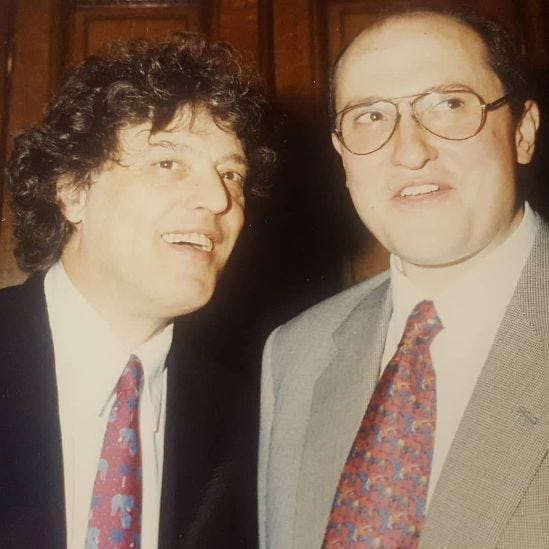
And here is a photograph taken at our bash. I have no idea what we were gossiping about but am certain I would have been struggling to keep up!
Do hurry if you want to catch Arcadia, which ends on Saturday.
.
"Far from finding fault, I can say, as co-author of a book which explores the scientific themes found in the play, that I felt moved to shout for an encore on its opening night." - I couldn't agree more
Love this Roger - Arcadia is my favourite play!