
The current debate about the use of AI in weather forecasting is fascinatingly foreshadowed by Pressure, the meteorological blockbuster starring Andrew Scott, Brendan Fraser, Kerry Condon and Damian Lewis.
Released today in the UK, having been available in America since May, Pressure tells the story of the most important forecast ever made by the Meteorological Office, which underpinned the crucial decision facing General Dwight D. Eisenhower (Fraser) on when to launch the largest seaborne invasion in history.
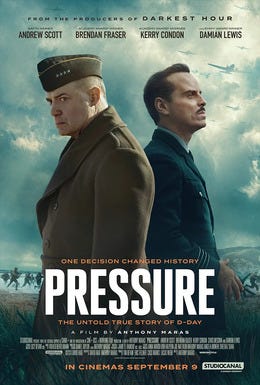
Based on David Haig’s 2014 stage play, the movie pivots around the clash between the Group Captain James Stagg (played by Scott), the Met Office man seconded to the Supreme Headquarters Allied Expeditionary Force as its Chief Meteorological Officer, and Col. Irving P. Krick (played by Chris Messina), the loudest advocate of a rival American approach, on the US Army Air Forces team charged with the nightmarish job of delivering the 1944 weather forecast that would determine whether D-Day was a success or disaster.
The movie is excellent – yes, there have been moans about accuracy but these grumbles are, inevitably, part of the genre - but what gripped me most of all is how it is a springboard for today’s debate about the use of AI in forecasting.
Krick and the US team subscribed to the “Analogue Method” of forecasting, which used current observations and compared them with previous weather patterns. Using historical charts, Krick would find one that matched current conditions and assumed the weather would follow the previous pattern.
By contrast, the British effort drew on the “Bergen School”, which helped move meteorology from subjective guesswork towards a science grounded in the laws of physics, such as fluid dynamics, radiation physics and thermodynamics.
That antagonism mirrors the central tension in forecasting today: whether to trust methods that learn from past patterns, or that simulate the atmosphere from physical first principles.
A typical ‘physics based’ weather forecasting computer model relies on a vast number of mathematical equations (known as partial differential equations) to simulate wind, rain and shine.
The same set of equations has to be solved at every one of millions of grid points, at a resolution of roughly10km for global models and 2km for regional ones. Moreover, today’s forecasters do not just make one forecast but ‘ensembles’ of many to take into account uncertainties. Unsurprisingly, these demand heavyweight computation – typically a supercomputer of some sort - and are often slow.
AI methods take a different route: rather than solving the physics explicitly, they identify statistically plausible weather patterns from historical measurements, echoing Krick’s analogue instincts, albeit a wholly different scale and sophistication.
These AI models, such as the FastNet model developed by the Met Office and the Alan Turing Institute, can perform to a similar level when compared with physics-based models and reality. Because these models are cheap to run once trained, you can generate vast numbers of possible forecasts for a fraction of the computational cost.
However AI weather models are trained on reanalyses of past weather that are themselves produced by physics-based models, while each new forecast has to start with current conditions generated the same way. So, although AI doesn’t have to solve all these equations in real time, it can’t get going without something that does.
There is a second, important, limitation. Because AI learns from past data, it can struggle with rare or unprecedented ‘black swan’ events and may underestimate extremes that sit beyond its training experience. To deal with extremes, physics-based forecasting is vital.
That point is underlined by Andrew Charlton-Perez and Ed Hawkins at the University of Reading, who combined newly digitised historical weather observations, contemporary weather science and an AI forecast to conclude that “modern AI forecasts would probably have supported the decision to delay the invasion on June 5, but would also have underestimated the severity of conditions of June 6.”
Their detailed paper, with colleagues, is published in Weather. Even with today’s technology, they say, the D-Day forecast would not have been an easy call, with the lives of 160 000 troops and the fate of the war in the balance.
I should add that while AI provides plausible answers it lacks ‘explainability’, the ability to show how it reached its conclusions. Physics-based models, by contrast, offer transparency.
As climate change alters global weather patterns, the lesson is not that AI should replace physics-based forecasting, nor that physics should ignore AI. The future will likely be hybrid: using the statistical muscle of AI alongside the theoretical rigour, transparency and knowledge embedded in physics-based models.
Importantly, as the Reading team point out, the movie also reminds us that human meteorologists – Stagg’s successors - will remain central to high-stakes forecasting in the near future.
I doubt this is what Anthony Maras, director of Pressure, had in mind when he remarked that “Pressure may be set over 80 years ago, but its themes are just as relevant today.” Yet, for me, that unexpected resonance gives the film a fascinating contemporary cadence.
For all those who want to find out more about the events behind Pressure, Imperial War Museums has, in partnership with the Met Office and Studiocanal, a display onboard the D-Day veteran ship, HMS Belfast, moored on London’s south bank, entitled Pressure: The D-Day Decision.
Among the items in the exhibition, which runs until 11 April next year, is Stagg’s diary, which covers the 72-hour period depicted in the movie. After advising Eisenhower to call off the invasion originally planned for 5 June, he wrote: “getting rather stunned – it is all a nightmare”.
Archived at: https://zenodo.org/records/24015715
What an interesting parallel. When I recommended a fellow journalist that he read up on how LLMs work (e.g. Anil Ananthaswamy's excellent Why Machines Think), he replied "Who cares, if the result is accurate?". Admittedly, not many - but a lot of people /will/ care about methodology if the answer is wrong!
I'm surprised there aren't more films about meteorology, such a fascinating topic. I'm still waiting for Hollywood to shine a light on Admiral "Hot Coffee" Fitzroy - whose creation of the Met Office is high drama, a tale of genius, madness, alchemy, science, hope, despair, grief and untimely death.
Excellent post Roger - looking forward to seeing the film even more now!