
I was rummaging around for something else entirely (if you insist, an article I wrote about Tracy the transgenic sheep) when I spotted it among my cuttings: a yellowing article published in The Daily Telegraph, Monday 15 January 1990, page 11. The headline declared: “Brookside’s bid to make science sexy”.
My little science page feature was about Alison Gregory, played by Alyson Spiro. She was a biochemist, a single parent and, as far as I could tell, the first scientist to become a regular character in a British soap. And she was thinking hard about joining the brain drain to America, lured by a bigger salary and more opportunity.

Brookside was the creation of Phil Redmond, now Sir Phil, who also gave us Grange Hill and Hollyoaks. These days he chairs the expert panel for the City and Town of Culture competitions, having persuaded a young Culture Secretary, Andy Burnham, to establish the UK City of Culture programme in 2009.
So when I heard him, at a BBC meeting last year, appeal for City of Culture to embrace science, I nearly fell off my treadmill desk. For years I’ve argued that science is a cultural activity. Here was someone with real clout saying the same thing.
I emailed him afterwards, giving my enthusiastic support. And, yes, I could not resist tacking on a jokey pitch for a science soap of my own, loosely based on my doctorate bouncing neutrons off soap bubbles in a nuclear reactor in Grenoble. Rival physicists. A fiery journalist. Bubbles popping to reveal the secrets of the universe, and so on.
Phil offered some gracious advice: I’d “have to occasionally tolerate gym-honed, manicured, fashion icons, cheating on each other and occasionally resorting to substance abuse, capital crimes and innovative ways to dispose of their victims… a typical day in the lab, perhaps?” I’m still working on it (don’t hold your breath).
Culture is Bigger than The Arts
In certain circles, a mention of culture conjures up opera, ballet, the Proms, or a gallery full of portraits. Among these traditionalists, science is mentally filed in the drawer marked ‘useful’, alongside plumbing and PowerPoint.
But if culture is the shared knowledge, practices and values of a society, science sits right at its heart. And, reassuringly, science has been busy making exactly this point. Researchers have found evidence of culture in other species, with the strongest and most diverse examples in chimpanzees. Different groups have their own traditions of tool use, grooming and even what look like rain dances, passed on by learning rather than genes.
The luvvies might think that’s a far cry from Covent Garden. I’d say that’s because they’re snobs. Culture is simply what a society does. By that test, penicillin and the periodic table are as much a part of our inheritance as Swan Lake. Even the apparently innocuous phrase ‘science and culture’ perpetuates the dated dichotomy, as though they are rival tribes in need of a peace treaty.
The split between science and the arts isn’t even that ancient. When Albertopolis was born in South Ken, they were joined at the hip. The collections that became the Science Museum and the V&A once belonged to the same South Kensington institution, founded on the idea that art, design, science and industry should enrich one another.
Then things splintered, and the institutions, the funding and eventually our brains followed. Today a science festival and an arts festival can sit in the same town on the same weekend and be funded by different machinery, with only the arts one allowed to call itself culture.
That has consequences. I was among the small army of people who fed into the Royal Society’s 2026 report, Science for Society, which recommended that science festivals and science and discovery centres should be able to benefit from the same financial incentives as cultural organisations. That it needed saying at all tells you how deep the divide still runs.
Phil put his finger on the anxiety this provokes on the other side. Because science has more cash than the arts, there’s a “fear culture will become minor player to promote science”. Agreed. But it’s a two-way street. The arts enrich science just as science enriches the arts, as we have seen with Stoppard’s Arcadia, science fiction and so much more.
Britain’s industrialists have long known this. Think of Henry Tate and his gallery, or William Lever and his collection, or Samuel Courtauld, or indeed Sir Henry Wellcome, who built a pharmaceutical empire and amassed an enormous and eclectic collection relating to medicine, much of which is now cared for by the Science Museum (you can see some spectacular examples in Medicine: The Wellcome Galleries).
But by 1959 the separation was entrenched enough for C.P. Snow, in his famous two cultures lecture, to describe a divorce between arts and sciences: the ‘literary intellectuals’ and the ‘physical scientists’ were separated by a ‘gulf of mutual incomprehension’. I agree with much of what he said but every time I hear the two cultures formulation, I reach for my Kalashnikov.
Science and the arts are the objective and subjective poles of a single culture, not separate planets.
Don’t believe me? Try this thought experiment. What would British culture and identity, look like if you stripped out science and engineering? You’d lose the steam engines, railways, vaccines, computers and the World Wide Web, obviously.
But tug on any one of those threads and other things unravel. Without the railways and the telegraph, there’s no standard time: Britain largely synchronised its clocks so the trains could run to a timetable. There’s no Football League either, at least not as we know it. No excursion trains to the seaside, and no fish and chips as a national dish, thanks to railways, ice and, later, steam trawlers. You’d also lose a lot of the people and places that shape how Britain understands itself, from Darwin, Brunel and Dorothy Hodgkin to Bletchley Park, the Royal Observatory and Jodrell Bank.
The real question is not how to make science part of culture. It’s why our cultural institutions, policies and conversations so often fail to notice it already is.
More Than Decorative: An Engine
I would go further than saying science is part of culture. It’s one of culture’s main engines, and distinctive too, because it has a self-correcting mechanism: claims are tested against evidence, criticised by others (‘nullius in verba’) and, where possible, independently replicated. Those safeguards are imperfect, but I can think of few other aspects of culture where scepticism is central to their method.
Thanks to mathematics and modelling, the predictive power of science is unmatched. Peter Higgs and others predicted “his” particle with mathematics in 1964. It took until 2012, some 10,000 scientists and engineers and the world’s largest scientific instrument, the Large Hadron Collider, to prove them right. Name another human enterprise that can lay this kind of bet, one that was as arcane as it was bold, and win it half a century later.
Science is still shaped by the rest of culture, of course, through its priorities, politics and ethics. But it reshapes other aspects of culture in turn. It changes how we see ourselves (evolution, neuroscience, the hunt for life on exoplanets), how we live (technology), what we argue about (genetics, climate, IVF) and how we think (evidence, models and a healthy dose of scepticism). No wonder it has proved an inspiration, from Mary Shelley to Ian McEwan.
Now we’re watching it happen all over again. AI is the most dramatic example I have witnessed in decades writing about research of where science, when applied through technology, is not just sitting within culture but changing it before our eyes. And yes, I believe that despite the extraordinary amount of AI BS we all have to wade through.
Mind your Language
Part of the problem is words. Phil wants to change what he calls the lexicon around creativity, curiosity and imagination, ditching labels such as “the arts”, “the sciences”, academic, vocational, STEM and STEAM. In their place, he suggested, we could “simply consider ‘learning’, discovery’, ‘innovation’ and ‘progress’”. Then, being Phil, he added: “or am I still a starry-eyed arts luvvy!? :-)”
If he is, I’m a starry-eyed science luvvy too. Take STEAM. Scientists reach for it when they want to stretch STEM to include the arts, but it’s an ugly acronym that reinforces the very divide it’s supposed to heal.
This matters beyond semantics. Economies run on science and technology, so countries can’t afford to compartmentalise it. People encounter new ideas through stories, museums, broadcasting, libraries, festivals and the character of the places where they live. If science and engineering are absent from those spaces, that puts a dent in national ambition.
If we want public trust in AI, science has to be woven into civic life. If we want more people to take up science and technology careers, they need routes beyond the purely academic. And if we want growth in places beyond London, science - and the story of how it has shaped society through technology - has to be visible in museums, festivals, libraries, civic architecture and community life across the country.
Phil is now looking ahead to the towns and cities of culture beyond 2028 and 2029 respectively. How about a modest first step, giving a nudge to places that are bidding to celebrate the science, engineering and innovation already woven into who they are? Stoke and its ceramics. Manchester, from textile mills to the Baby computer and graphene. Dundee, from jute to video games. Swindon and the railway.
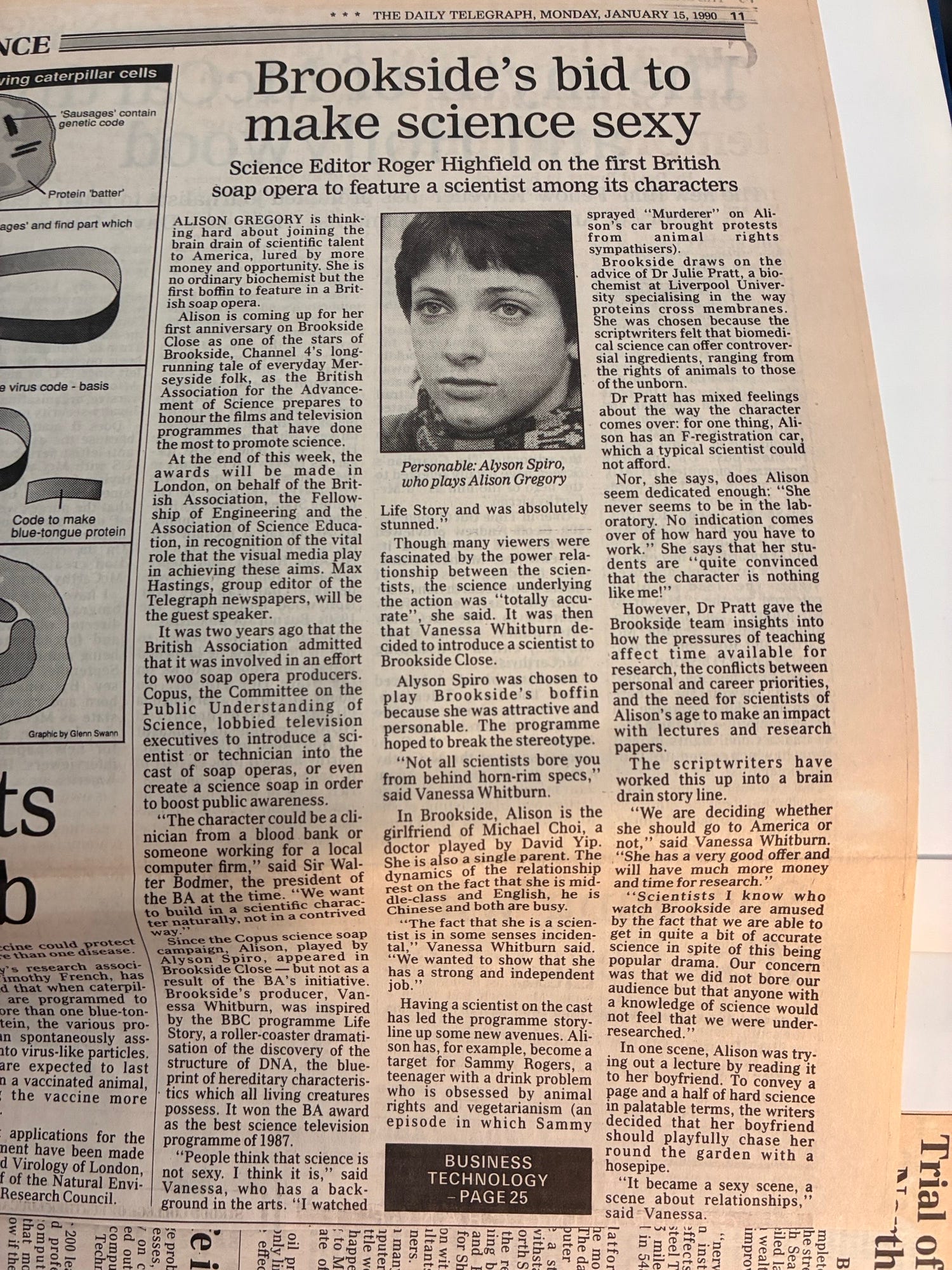
When I sent him that old Brookside cutting a few weeks ago, his reply was brief: “as your cutting indicates - the journey began a few years back…:-)”
Thirty-six years, give or take. I’ve no idea whether Alison Gregory ever took that job in America, and my atomic soap opera is still waiting for its commission. But it’s time we told the fuller story of Britain, one in which science, engineering and mathematics sit alongside the arts at the heart of our culture. They all spring from the same human imagination.
Archived at: https://zenodo.org/records/23956241
I couldn't agree more. We're having the same conversation in the north east as our mayoral authority develops it's culture strategy (overseen by the same director as 'innovation'). I feel like I've been having this conversation for all my 22 years at the Centre for Life...